

Best Alternatives to Bulk Custom T-Shirt Orders in 2026
Table of Contents
- Why Bulk Custom T-Shirt Orders Are Losing Their Edge
- Print on Demand vs Screen Printing: The Real Cost Comparison
- Low Minimum Custom T-Shirt Printing: Where to Start
- Best Sites for Custom Graphic Hoodies and Tees
- No Minimums, No Setup Fees: What to Look For
- Quality Testing and Sample Ordering Before You Commit
- Inventory Management for Small Businesses Using On-Demand
- Integrating Custom Apparel with Your E-Commerce Platform
- Frequently Asked Questions
Last Updated: September 10, 2026
Why Bulk Custom T-Shirt Orders Are Losing Their Edge
The math that made bulk custom t-shirt orders a no-brainer for years has quietly stopped working. Storage costs, dead stock, and locked-in designs now eat into the savings that volume pricing once delivered. This guide from Ortrends walks through the bulk custom t-shirt alternatives that actually make sense in 2026, from low-minimum printing to on-demand fulfillment.
Here's the tension most guides skip: bulk ordering optimizes for unit price, not total cost. A screen-printed run of 500 shirts looks cheap per piece until you're storing 300 of them in a garage, writing off unsold sizes, and eating a design you can't change. On-demand flips that equation. You pay more per shirt and less per mistake.
That trade-off is the throughline for everything below. We'll compare print methods, minimums, platforms, and the hidden costs that decide whether bulk or on-demand wins for your situation.
Print on Demand vs Screen Printing: The Real Cost Comparison
Print on demand vs screen printing comes down to one question: do you want to pay for inventory or pay per unit? Screen printing rewards volume with lower per-piece costs but requires upfront runs, setup fees, and storage (sba.gov). Print on demand produces each item only after it sells, so there's no dead stock, no minimums, and no setup fees.
The catch is unit cost. On-demand printing typically costs more per shirt because each item is produced individually rather than in a batch. Screen printing spreads its setup across hundreds of units, so the per-piece price drops as quantity rises.
What most comparisons miss is that the cheaper unit price isn't the cheaper decision. Once you factor in unsold inventory, storage, and the cost of guessing wrong on sizes, the gap narrows fast. For a small brand testing designs, on-demand usually wins. For a proven design selling in steady volume, screen printing can still come out ahead.
The Cost Factors That Actually Move the Number
Every quote you receive breaks down into the same handful of line items. Compare them side by side before you decide:
- Blank garment cost, the wholesale price of the tee itself. On-demand services bundle this into the per-item price; screen printers quote it separately and it drops at higher quantities.
- Screen or setup charge, screen printing charges per screen, and a screen is required for each color in each design. A three-color design on a 50-piece run carries three setup charges. On-demand has none.
- Print cost per location, front, back, and sleeve prints are priced separately by screen printers. On-demand platforms usually price per print area too.
- Minimum quantity, screen printers commonly set floors in the 12-50 unit range per design. On-demand floors are typically one unit.
- Shipping and handling, bulk runs ship once in a box; on-demand ships per order, so shipping is charged to the end customer or absorbed by you.
- Storage and shrinkage, bulk inventory occupies space and can be damaged, stained, or lost. On-demand holds nothing.
- Unsold inventory write-off, the cost of every shirt you ordered but never sold.
How to Calculate Cost Per Unit for Both Methods
Cost per unit is the total you spend divided by the number of shirts you actually sell, not the number you order. That distinction is where bulk math falls apart.
Use this formula:
Cost per unit = (Product cost + Setup fees + Shipping + Storage + Unsold inventory) ÷ Units sold
Run it against both methods with your own numbers:
| Cost Factor | Screen Printing (Bulk) | Print on Demand |
|---|---|---|
| Per-shirt cost | Lower at high volume | Higher per unit |
| Setup fees | Charged per design and color | None |
| Minimum order | Often 12-50+ units | Usually 1 unit |
| Storage | You store the run | None |
| Unsold inventory | Your loss | None |
| Design changes | New setup each time | Free to swap |
A Worked Example Framework
Plug your own figures into this structure. Say a screen printer quotes a low per-shirt rate on a 100-piece run, plus a setup charge per color. Add the shipping on the full run. Now assume you sell through only part of the run in the first season and carry the rest as storage. Divide your total spend by the units you actually moved. Compare that number against the on-demand per-item price for the same garment.
The pattern most sellers find: on-demand wins clearly below roughly a few dozen units sold per design, screen printing wins clearly above several hundred, and the middle is a judgment call driven by how confident you are in the design. Run the formula with your real numbers rather than trusting a rule of thumb, the crossover point depends on your setup charges, your sell-through rate, and how long you're willing to sit on stock.
When Each Method Wins
- Choose on-demand when: you're testing new designs, selling made-to-order or personalized items, running a store with unpredictable demand, or you have no space to store inventory.
- Choose screen printing when: you have a proven design with steady reorders, you need a large identical run for an event or team, or you can commit to a quantity you're confident you'll sell through.
- Consider a hybrid when: you launch designs on-demand, then move your proven winners to a bulk run once sell-through data justifies it. This is the lowest-risk path for most small brands.
Low Minimum Custom T-Shirt Printing: Where to Start
Low minimum custom t-shirt printing lets you order in small batches, often as few as one item, so you can test a design before committing to a full run. This is the entry point most small sellers and gift buyers should start with.
The appeal is simple: you learn what sells before you spend on volume. Order a handful of designs, see which ones move, then scale the winners through bulk if the numbers justify it.
What "Low Minimum" Actually Means Across Service Types
The phrase covers a wide range, and the range matters:
- True single-item on-demand, no minimum at all. You order one shirt, it's printed after purchase, and there's no setup charge. Per-unit price is the highest of any option.
- Small-batch digital printing, many print shops will run a handful of pieces using direct-to-garment or digital methods with no screen setup. Minimums are often in the single digits, and per-unit pricing sits between on-demand and bulk.
- Low-minimum screen printing, some shops will screen print as few as a dozen or so pieces per design. You pay setup charges per color, which makes the per-unit price steep at the low end but drops quickly as quantity climbs.
- Marketplace and design-upload platforms, you supply artwork, the platform prints and ships per order. No minimum, but you generally can't order a finished, ready-made design, you bring your own.
The Sample Order: Your Cheapest Insurance
Before you commit to any run, small or large, order a single test piece. This is the step most guides skip, and it's the one that prevents the most expensive mistakes.
A practical sample workflow:
- Order one unit of the exact garment and print you're considering. Not a similar product, the same one.
- Inspect the print in daylight. Check color accuracy against the artwork you approved, and look for misalignment or off-center placement.
- Stretch the print gently. A quality print flexes with the fabric without cracking or flaking. If it cracks on a light stretch, it won't survive a wash cycle.
- Check the fabric hand. Is it soft and substantial, or thin and stiff? Fabric weight and feel vary widely between blanks, and the mockup won't tell you.
- Verify fit against the size chart. Order your own size so you can judge the cut on a real body.
- Wash it once, inside out, following the care label (the FTC). Recheck the print and the shape afterward. This is the only real durability test.
If the sample passes, you've de-risked the run. If it fails, you've spent the price of one shirt instead of the price of a hundred.
Practical Rules for Starting Low
- Test 3-5 designs at once to get real signal, not one.
- Order one unit per size when fit is uncertain, so you can confirm the size chart before scaling.
- Keep a spreadsheet of which designs sell and at what margin, so your scaling decision is based on data.
- Only scale to bulk once a design sells consistently and you can forecast demand.
- Reorder a sample from a new printer before switching, even if the price looks better.
This approach also protects your cash flow. You're not tying up money in inventory that might sit for months.
Best Sites for Custom Graphic Hoodies and Tees
The best sites for custom graphic hoodies balance print quality, minimums, turnaround, and design options. The right pick depends on whether you're buying for yourself, for gifts, or to resell.
For most buyers who want original designs without bulk commitments, Ortrends is our top pick. The brand offers made-to-order graphic apparel, including T-shirts and hoodies, built around original and meaningful prints rather than generic clip-art. Collections cover nurses, pet lovers, and positive-living themes, which means the designs feel intentional rather than mass-produced. Every piece is made to order and shipped from California, so there's no warehouse of unsold stock and no minimum to hit.
What sets Ortrends apart for gift buyers and self-expression shoppers is the design focus. Customers consistently mention print quality and comfort, with one noting "the shirt quality is amazing and the design looks even better in person." Another bought a Father's Day tee and found "the print was clean and the fit was great."
The trade-off is honest: Ortrends is a curated made-to-order shop, not a bulk screen-printing house. If you need 500 identical shirts for an event next week, that's a different tool. If you want one great hoodie with a design that means something, it fits.
Other options in this space include large marketplaces where independent designers upload artwork, and general on-demand platforms that let you apply your own design to a blank. Those work well if you already have artwork and just need a printer. They're less useful if you want a ready-made, original design you can wear or gift today.
No Minimums, No Setup Fees: What to Look For
No minimums and no setup fees are the two features that separate true on-demand printing from bulk with a friendly label. Here's what to check before you commit.
- True no-minimum: Can you order a single item with no penalty? Some services advertise "low minimums" but charge more per unit below a threshold.
- No setup fees: Screen printing charges per design and per color. On-demand should not.
- Transparent shipping: Know the turnaround and where it ships from before you order.
- Design flexibility: Can you swap designs freely, or is each new design a new cost?
- Return and reprint policy: What happens if a print arrives flawed?
Quality Testing and Sample Ordering Before You Commit
Sample ordering is the single best way to avoid a bad print run. Order one item first, inspect it in person, and only scale once you're satisfied. No photo or mockup replaces holding the actual garment.
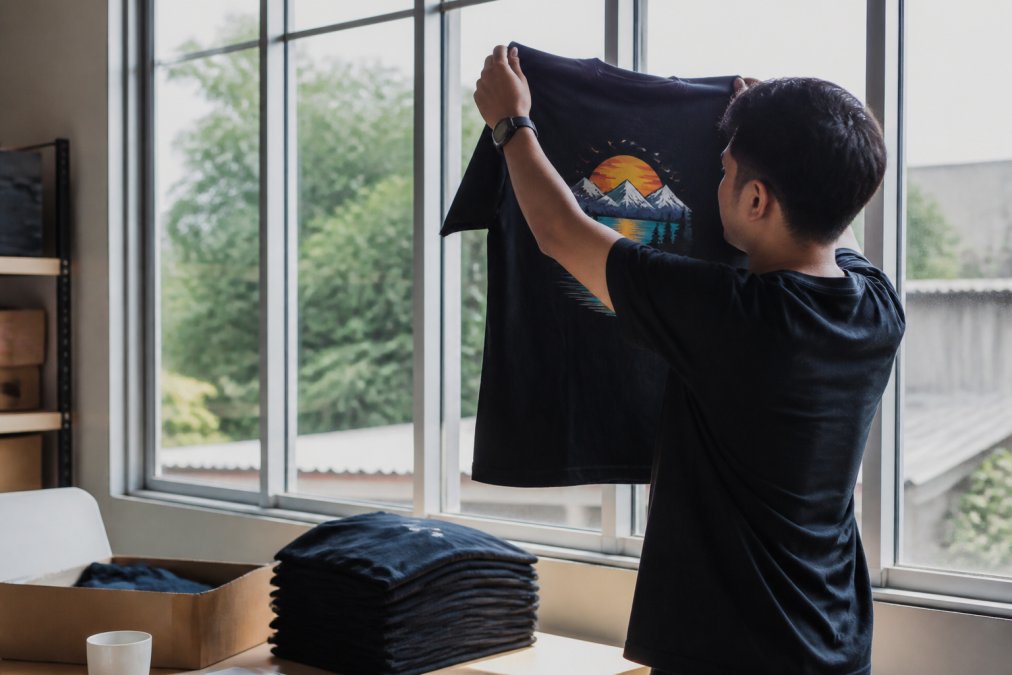
When your sample arrives, check these:
- Print durability: Stretch the print gently. A quality print flexes without cracking.
- Color accuracy: Does the printed color match what you approved?
- Fabric feel: Is the material soft and substantial, or thin and stiff?
- Fit and sizing: Does it match the size chart?
- Wash test: Wash it once and recheck the print and shape.
This step matters more for on-demand than bulk, because you can't inspect a batch before it's produced. The sample is your only preview.
Inventory Management for Small Businesses Using On-Demand
On-demand printing removes most inventory headaches, but it doesn't remove inventory management entirely. You still need to track what's selling, what's not, and where your margin sits.
The advantage is that you hold no physical stock. Your "inventory" is your catalog of designs and your sales data. That means your management job shifts from counting boxes to reading numbers.
A simple system for small sellers:
- Track sales per design weekly
- Retire designs that don't move after a set period
- Double down on the top sellers by promoting them harder
- Keep your catalog lean so customers aren't overwhelmed
This is where on-demand beats bulk for small businesses. You can't get stuck with 200 unsold shirts if you never ordered them.
Integrating Custom Apparel with Your E-Commerce Platform
Connecting custom apparel to your store is what turns a side project into a scalable operation. Most on-demand services integrate with major platforms so orders flow automatically from sale to production.
The workflow looks like this: a customer buys, the order routes to the printer, the item is produced and shipped, and you never touch inventory. For sellers on platforms like Shopify or Etsy, this removes the fulfillment bottleneck that stalls most small apparel brands (shopify.com).
What to confirm before integrating:
- Does the service sync orders automatically, or do you upload manually?
- Are tracking numbers pushed back to your store?
- Can you set your own retail prices on top of production cost?
- Does it support the sizes and products you sell?
Get those four right and your store runs without you packing a single box.
The real challenge with custom apparel isn't finding a printer. It's choosing between paying for inventory you might not sell and paying more per unit for the freedom to sell only what you make. For most small sellers, gift buyers, and anyone who wants original designs without a bulk commitment, that freedom is worth it. Ortrends makes that choice easy with made-to-order graphic tees and hoodies, original and meaningful prints, premium quality materials, and fast shipping from California. Get started with Ortrends and wear something that actually means something.
Frequently Asked Questions
What is the cheapest way to make custom t-shirts without ordering in bulk?
Print-on-demand services charge per item with no minimums, so you pay only for what you need. For a single shirt, that usually costs more per unit than a bulk screen-printing run, but you avoid dead inventory and upfront setup fees. If you need 10 or fewer shirts, print-on-demand is typically the most affordable route. For larger orders, compare the per-unit cost of bulk custom t-shirt printing against on-demand pricing to see which fits your budget.
Can I order custom t-shirts without meeting high minimum quantities?
Yes. Many print-on-demand platforms and low minimum custom t-shirt printing services let you order as few as one item. This is ideal for small businesses, gifts, or testing a design before scaling. You won't get the deep discounts of bulk orders, but you also won't be stuck with unsold stock. Look for services that explicitly state 'no minimums' and check whether they charge setup fees or require minimum order values.
How does quality compare between bulk screen printing and direct-to-garment printing?
Screen printing typically produces thicker, more durable prints that withstand many washes, especially on dark fabrics. Direct-to-garment (DTG) prints are softer and can handle complex, full-color designs, but they may fade faster if not cared for properly. The best choice depends on your design and how long you need the shirt to last. Always order a sample to test print quality and fabric feel before committing to a large run.
What are the best sites for custom graphic hoodies if I want unique designs?
The best sites for custom graphic hoodies offer a mix of original designs, quality materials, and easy customization. Look for platforms that specialize in made-to-order apparel with no minimums, like Ortrends, which focuses on unique, expressive prints for niches like nurses and pet lovers. Check customer reviews for print durability, fabric softness, and shipping speed. Avoid sites that rely on generic clipart; instead, seek out artists and brands that create original artwork.