

Can You Return Custom Printed Shirts? 2026 Guide
Table of Contents
- Why Custom Printed Shirts Sit in a Different Return Category
- The Standard Print on Demand Return Policy, Explained
- Can You Return Custom Printed Shirts? What Refund Eligibility Actually Requires
- How to Handle Defective Custom Apparel Without Losing the Claim
- Return Windows, RMAs, and the Paperwork That Decides Your Refund
- The Digital Proof Approval That Quietly Kills Most Refund Requests
- Consumer Protection vs. Custom Goods: What the Law Does and Does Not Cover
- Store Credit, Exchanges, and Sustainable Disposal of Rejected Prints
- Frequently Asked Questions
Last Updated: September 16, 2026
Why Custom Printed Shirts Sit in a Different Return Category
Can you return custom printed shirts? In most cases, no, not for a change of mind. The reason is simple: a custom printed shirt is made specifically for you, with your design, your size, and your specifications baked in before a single screen touches fabric. According to the FTC's business guidance on refunds and returns, sellers may set their own return policies as long as those policies are disclosed clearly before purchase. That's the legal backbone behind the strict policies you see across the print on demand industry.
This guide from Ortrends covers what actually qualifies for a refund, what doesn't, and how to protect yourself when something genuinely goes wrong.
Here's the tension most buyers don't see coming. A blank shirt from a big-box retailer can go back on a shelf. A personalized shirt with your golden retriever's face on it cannot. Once that design is printed, the item has no resale value to anyone but you. That single fact drives every return policy in this corner of the apparel industry.
Print on demand return policy structures exist because made-to-order production leaves slim margins. A returned custom item isn't restocked, it's usually written off. That's why retailers draw a hard line between "I changed my mind" and "you sent me something defective."
The good news: that line is not as rigid as it looks. If your order arrives misprinted, materially flawed, or simply isn't what you approved, you have a legitimate claim. Below, we'll show you exactly how to tell the difference and how to win the claims that are actually winnable.
The Standard Print on Demand Return Policy, Explained
The standard print on demand return policy allows refunds or replacements only for items that arrive defective, damaged, or different from what was approved. Change-of-mind returns on personalized goods are almost universally excluded. Navigating these standard return policies requires a clear understanding of how small business apparel operations manage inventory risks and customer expectations.
That's the short answer. Here's what sits underneath it.
Most made-to-order apparel sellers build their policy around three ideas: the item is bespoke, the production cost is already spent, and the customer approved the design before printing. Each of those ideas shifts risk away from the seller and onto the buyer, which is exactly why you need to understand your use points before you order, not after.
What Blank Apparel Rules Do Not Apply to Custom Orders
Blank apparel rules do not apply to custom orders because customization converts a returnable product into a personalized good. A plain tee bought in the wrong size can be exchanged. A tee printed with a design you approved cannot be resold, so the exchange logic collapses.
This is the single most common misunderstanding in the category. Shoppers carry habits from regular retail into custom orders and assume the same flexibility follows them. It doesn't.
- Blank apparel: returnable, exchangeable, often restocked and resold
- Custom printed apparel: made to order, personalized, typically final sale unless defective
- The pivot point: the moment your design goes to print, the item stops being inventory and becomes yours
Can You Return Custom Printed Shirts? What Refund Eligibility Actually Requires
Can you return custom printed shirts? Yes, but only when the item is misprinted, materially flawed, or different from the approved design. Those three conditions are the entire basis for a valid claim in nearly every policy you'll encounter.
Everything else, wrong size ordered, design you no longer like, a color that reads differently in person, falls outside refund eligibility. Harsh, but consistent across the industry.
Misprinted, Materially Flawed, or Wrong Item: The Only Three Valid Claim Types
Misprinted means the print itself is wrong: off-center, crooked, faded, missing a color, or placed on the wrong area of the garment.
Materially flawed means the garment fails as a garment: a seam splits, a hole appears, the fabric is damaged, or the print peels within normal wear.
Wrong item means you received something other than what you approved: incorrect size, wrong color, or a completely different design.
If your issue fits one of those three boxes, you have a claim. If it doesn't, you're asking for a favor, not enforcing a policy, and you should expect the answer to be no.
A common mistake is describing a valid claim in invalid language. Saying "I don't like how it looks" sounds like buyer's remorse. Saying "the print is 2 inches off-center from the approved proof" sounds like a defect. Same shirt, very different outcome.
How to Handle Defective Custom Apparel Without Losing the Claim
Handling defective custom apparel starts with documentation, not complaint. Photograph the flaw the day the order arrives, keep the packaging, and contact support with your order number and proof of purchase before you wash or wear the item.
That sequence matters more than most people realize. Claims weaken fast when the item has been worn, washed, or altered.
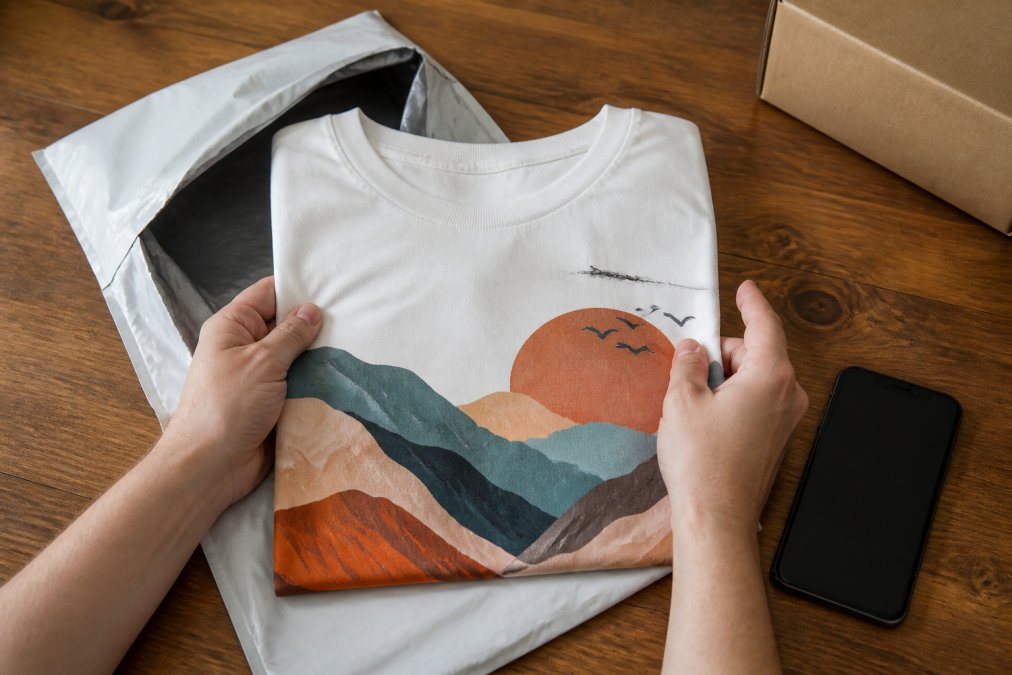
The Quality Control Checklist to Run the Day Your Order Arrives
Run this checklist before the tags come off. It takes about two minutes and it's the difference between a clean claim and a rejected one.
- Open the package and lay the garment flat in good lighting
- Compare the print position against your approved digital proof
- Check print edges for fading, cracking, or missing color
- Inspect seams, hems, and collar for splits or loose stitching
- Confirm the size on the label matches your order
- Photograph any flaw from two angles, plus one wide shot of the whole item
- Save the original packaging and packing slip
- Contact support within the return window, before washing or wearing
What Counts as 'Materially Flawed', A Working Definition
"Materially flawed" is the phrase that decides most disputes, and it is narrower than buyers assume. A flaw is material when the garment fails to function as a garment or the print fails to match the approved proof in a way that is visible in normal use. A loose thread that doesn't unravel is not material. A seam that splits after one wear is. A print that is 1/8 inch off-center is usually within tolerance; a print that is 2 inches off-center is not.
Use this three-part test before you file:
- Visibility, Can the flaw be seen without a magnifying glass, in ordinary light, from a normal viewing distance?
- Function, Does it affect wearability, fit, or the print's legibility?
- Deviation, Does it differ from the approved proof or the product description in a measurable way?
If you can answer yes to at least two of those three, you have a claim worth filing. If you can only answer yes to one, expect the seller to push back, and prepare your evidence accordingly.
The Legal Backstop: Why Timing and Documentation Decide Claims
The FTC's Mail, Internet, or Telephone Order Merchandise Rule sets the baseline expectation that sellers must ship within the time promised or, if no time is promised, within 30 days, and must offer a refund if they cannot. That rule is your leverage when an order never arrives or arrives materially different from what was described. It does not, however, override a clearly disclosed final-sale policy on custom goods, which is why the paperwork matters as much as the flaw itself.
A common pattern in denied claims is not a bad defect, it is a missing date. Sellers log the delivery date, the date you first contacted them, and the date you provided photos. If any of those gaps is too wide, the claim can be denied on timing alone, even when the defect is obvious. File the day you notice, not the day you get around to it.
Return Windows, RMAs, and the Paperwork That Decides Your Refund
Return windows for custom apparel are typically short, often measured in days from delivery, not weeks. Miss the window and even a legitimate defect claim can be denied on timing alone.
The return merchandise authorization (RMA) is the formal step that opens a claim. You request it, the seller issues a number, and that number ties your return to their system. Without an RMA, a returned package can arrive with no record attached to it.
What you'll need ready:
- Order number and proof of purchase
- Photos of the defect or misprint
- The approved digital proof, if you have it
- A brief written description of the problem
- The original packaging, where possible
Keep every message in writing. Email and chat logs create a paper trail that protects you if the claim gets disputed. A phone call feels faster, but it leaves nothing behind.
Business days matter here too. A "5-day window" usually means five business days, which can stretch across a weekend and a holiday. Read the clock the way the policy reads it, and file early rather than on the last day.
The Digital Proof Approval That Quietly Kills Most Refund Requests
Digital proof approval is the single biggest reason custom apparel refund requests get denied. When you approve a proof, you confirm the design, placement, colors, and spelling. If the finished shirt matches that proof, the seller has delivered exactly what you signed off on.
This is where most disputes die, and it's almost always avoidable.
The proof is your last chance to catch problems while they're still free to fix. Read it slowly. Check every letter of every word, especially names. Zoom in on placement. Confirm the color against what you expect, remembering that screen colors and printed ink don't always match perfectly.
If the finished product matches the proof, a refund request based on "it's not what I wanted" won't hold. If it doesn't match, you have documented evidence, and that's a claim the seller has to answer.
Consumer Protection vs. Custom Goods: What the Law Does and Does Not Cover
Consumer protection law covers deceptive practices, undelivered goods, and items that don't match their description. It does not guarantee a refund for personalized goods you simply changed your mind about.
That distinction trips up a lot of buyers. Federal and state consumer protection rules generally target unfair or deceptive conduct by sellers, not buyer's remorse. If a seller ships you a misprinted shirt and refuses to make it right, that can fall under deceptive practice. If a seller ships you exactly what you approved and you no longer want it, that's not a consumer protection issue.
The FTC's guidance on mail, internet, and telephone order merchandise sets expectations around delivery timelines and what happens when goods don't arrive as promised. Those rules protect you when a seller fails to deliver. They don't override a clearly disclosed final-sale policy on custom goods.
So where does that leave you? Read the policy before you buy, keep your proof of purchase, and understand that the law backs you on defects and non-delivery, not on preference. That's not a loophole for sellers; it's the tradeoff that makes made-to-order pricing possible in the first place.
Store Credit, Exchanges, and Sustainable Disposal of Rejected Prints
Store credit and exchanges are the most common remedies for custom apparel issues, and they're often more generous than the headline policy suggests. Many sellers would rather issue credit than fight a claim, especially when the defect is clear.
Where a refund isn't offered, ask what is. Some sellers will reprint a defective item at no cost. Others issue store credit for the value of the order. Exchanges for the same design in a corrected size or print are common when the flaw is on their end.
The Remedy Hierarchy: What to Ask For, In Order
Not all remedies are equal, and the order in which you ask matters. Work down this list rather than jumping straight to a refund demand:
- Free reprint of the defective item, best outcome when the design is still wanted and the flaw is the seller's fault. Costs you nothing and preserves the order.
- Full refund to the original payment method, the strongest remedy, usually reserved for items that cannot be reprinted or where the seller cannot deliver a correct version.
- Store credit for the order value, common when the seller's policy excludes cash refunds on custom goods. Acceptable if you plan to order again; less useful if you don't.
- Partial credit or discount on a future order, a fallback when the flaw is minor and the seller disputes materiality. Take it only if the flaw is genuinely minor.
- Exchange for the same design in a corrected size or color, applies when the error is on the seller's side, not yours.
A practical lever: ask for the reprint first. Sellers are far more willing to reprint than to refund, and a reprint solves the actual problem, you get the shirt you wanted. If the reprint also arrives flawed, you now have a documented pattern, which strengthens a refund demand considerably.
What Happens to Rejected Prints, and Why It Matters
Custom items usually can't be restocked. Once a design is printed, the item has no resale value to anyone but the original buyer, so returned and misprinted stock is typically written off rather than resold. That write-off is the hidden cost that makes sellers strict about change-of-mind returns in the first place.
The sustainable move is to keep that fabric out of the trash. Rejected prints can become:
- Cleaning rags, cut into squares for household use
- Donation items, many charities accept clean, unworn apparel regardless of print
- Craft and quilting fabric, the printed panel can be cut and reused
- Textile recycling, a growing number of municipal programs and retail drop-offs accept worn or printed fabric for fiber recovery
If you're stuck with a flawed shirt that isn't worth returning, don't bin it. Repurpose it. It's a small habit that keeps a lot of wearable fabric out of the waste stream, and it's a question almost no return policy answers, which is exactly why it's worth asking your seller directly.
Frequently Asked Questions
Are custom printed shirts returnable?
In most cases, no. Custom printed shirts are made to your design specifications, so they count as personalized goods and fall under final sale terms at nearly every print on demand seller. The exception is a misprinted, materially flawed, or wrong item. If the print is off-center, the fabric arrives torn, or you receive a different design than approved, that is a manufacturing defect and the seller covers a replacement or refund. Always check the return window before ordering.
What is the standard return policy for print-on-demand apparel?
A typical print on demand return policy allows claims only for defects, misprints, or incorrect items, usually within 14 to 30 days of delivery. Blank apparel rules like free size exchanges or change-of-mind returns do not apply because each shirt is produced after you order. You will normally need proof of purchase, photos of the flaw, and the original packaging. Approved claims are settled with a reprint, store credit, or refund rather than a standard return.
Can I get a refund if my custom shirt is defective?
Yes, if you can show the defect clearly and file inside the return window. Photograph the issue in daylight, include the packing slip or order number, and describe what went wrong in one or two sentences. Most sellers verify the defect against their quality assurance records before approving. Do not wash or wear the shirt first, since that can void the claim. Once verified, you typically get a free reprint or a refund to your original payment method.
Do companies offer exchanges for custom apparel?
Size exchanges are rare on custom apparel because the item cannot be resold. A few sellers offer exchanges for blank, unprinted stock, but printed goods usually fall under final sale. If your shirt does not fit, the practical route is to order the correct size at your own cost. Some sellers issue store credit as a goodwill gesture, so it is worth asking customer support before assuming the answer is no.
Why are personalized items usually non-returnable?
Personalized goods cannot be restocked and resold, so a change-of-mind return leaves the seller holding inventory nobody else wants. Print shops run on slim margins, and each custom job ties up materials, labor, and screen setup time. That is why the industry treats customization as a final sale and limits refunds to defect verification. Consumer protection rules generally recognize this distinction between bespoke items and standard retail goods.