

How Long Does Made-to-Order Clothing Take: Complete Timeline
Table of Contents
- How Long Does Made-to-Order Clothing Actually Take?
- Made-to-Order vs. Ready-to-Wear: What's the Real Difference?
- Factors Affecting Custom Clothing Delivery Times
- Custom Clothing Production Timeline: What Happens at Each Stage
- Rush Orders and Expedited Shipping: Is It Possible?
- Tracking Your Order: Digital Transparency and Order Status Updates
- Planning Ahead: Tips for Ordering Made-to-Order Clothing Without Stress
- Conclusion
How Long Does Made-to-Order Clothing Take: Complete Timeline
Last Updated: August 4, 2026
How long does made to order clothing take? Most custom garments ship within 2-4 weeks from order confirmation. At Ortrends, we've tracked production timelines across hundreds of made-to-order apparel orders, and the reality is far more nuanced than a single number. Understanding what influences your delivery window, from design complexity to seasonal demand, helps you plan better and set realistic expectations.
The made to order clothing production process involves multiple stages that don't exist in ready-to-wear manufacturing. Each step, from design confirmation through quality checks to final shipping, adds time. What most customers don't realize is that the difference between a 2-week turnaround and a 6-week wait often comes down to decisions made before production even begins.
According to Statista's 2026 E-commerce Report, custom apparel represents one of the fastest-growing segments in online retail, yet delivery expectations remain misaligned with production realities. This guide walks you through exactly what happens during each phase, what factors speed things up or slow them down, and how to plan your orders strategically.
How Long Does Made-to-Order Clothing Actually Take?
The typical turnaround time for made to order clothing ranges from 10-21 business days for standard orders, with most falling in the 14-18 day window. This timeline assumes no customization delays, standard production capacity, and domestic U.S. shipping. Rush orders can compress this to 5-7 business days, though expedited production comes with trade-offs in quality control and availability.
What complicates the picture is that "turnaround time" means different things depending on when you start counting. Some vendors measure from order placement, others from design approval, and still others from when production actually begins. At Ortrends, we focus on the production-to-shipment window, the moment your design is locked in to when your package leaves our California facility.
Lead time variability also depends on garment type. A simple graphic t-shirt with a single-color print typically takes 10-14 days. A hoodie with multi-color embroidery or complex custom design can stretch to 21-28 days. Seasonal demand spikes, particularly around Father's Day, Mother's Day, and the holiday season, can add 5-10 days even for standard orders.
Why Custom Garments Take Longer Than Ready-to-Wear
Ready-to-wear clothing ships in 2-5 days because it's already manufactured in bulk and sitting in warehouses. Made-to-order clothing doesn't exist until you order it. The garment construction begins after payment clears and your design is approved. This fundamental difference, making something specifically for you rather than pulling it off a shelf, is why the production cycle is longer.
The manufacturing methods differ significantly. Ready-to-wear uses high-speed automated production lines optimized for volume and speed. Made-to-order production typically involves smaller batch runs, more hand-crafted elements, and quality checks at multiple stages. For premium apparel like Ortrends offers, this means higher-quality materials and more careful attention to detail, but it requires more time per garment.
Another factor is material sourcing. Ready-to-wear manufacturers maintain massive inventories of standard fabrics. Custom orders often require specific material selections, and if your chosen fabric isn't in stock, the fulfillment time extends. High-quality materials that keep their shape after dozens of washes sometimes require longer lead times from suppliers.
Made-to-Order vs. Ready-to-Wear: What's the Real Difference?
The production cycles of these two models are fundamentally opposite. Ready-to-wear operates on a forecast model: manufacturers predict what customers will want, produce massive quantities 6-12 months in advance, and hope inventory sells before the next season. Made-to-order operates on a pull model: you order, then production happens.
Ready-to-wear production cycles are 4-6 months from design conception to warehouse stocking. Made-to-order production cycles are 2-4 weeks from order to delivery. One happens in bulk far in advance; the other happens in small batches on demand.
Made-to-Measure vs. Made-to-Order
These terms are often confused, and the distinction matters for your timeline. Made-to-measure means a garment is constructed to your specific measurements, typically through a fitting process with a tailor or designer. Made-to-order means a garment is manufactured according to your design specifications, but usually in standard sizing.
Made-to-measure adds 1-3 weeks to the production schedule because it includes a fitting appointment, pattern adjustments, and often a second fitting after initial construction. Made-to-order, as offered by Ortrends, skips the fitting appointments and produces in standard sizes, so the production cycle is faster, typically 2-4 weeks total.
Factors Affecting Custom Clothing Delivery Times
Several variables determine whether your order arrives in 10 days or 28 days. Understanding these factors helps you estimate your own timeline and plan accordingly.
Design Complexity and Customization Level
Simple designs ship faster than complex ones. A single-color graphic on a t-shirt takes 10-14 days. A multi-color design with embroidery or intricate details can take 21-28 days. If your design needs revision after initial approval, add 2-3 days per revision cycle.
The number of customization options also matters. Choosing one garment color and one design is faster than choosing from multiple options or requesting personalization like names or dates. Each customization adds a step to the production process.
Vendor Workload and Production Capacity
During peak seasons, even fast manufacturers slow down. Father's Day, Mother's Day, and the December holiday season create bottlenecks. Orders placed during these periods can take 25-35% longer than orders placed during off-peak times.
A manufacturer running at 60% capacity can turn orders faster than one running at 95% capacity. Reputable vendors maintain consistent timelines by managing capacity carefully rather than accepting unlimited orders.
Seasonal Demand Fluctuations
Orders placed in May for Father's Day gifts often ship 20-25 days later because the vendor is managing hundreds of similar orders. Orders placed in January for the same vendor might ship in 12-15 days.
Holiday seasons, particularly October through December, see 40-50% increases in custom apparel orders. If you need something by December 25th, ordering by early December is risky. Most vendors recommend ordering by November 20th for December delivery.
Material Availability and Supply Chain
Standard fabrics in common colors ship immediately. Specialty fabrics, unusual colors, or high-demand materials may require 5-10 additional days if they're not in stock. Quality vendors communicate material delays proactively.
The quality of materials also influences production speed. Premium fabrics that maintain their shape through dozens of washes sometimes require longer lead times from suppliers. This is part of why Ortrends' apparel lasts longer than cheaper alternatives.
Custom Clothing Production Timeline: What Happens at Each Stage
Understanding the production process demystifies the timeline. Each stage has a typical duration, and knowing what happens when helps you track your order and understand delays.
Order Processing and Design Confirmation
This stage typically takes 1-2 business days. Your order is received, payment is verified, and your design specifications are logged into the production system. You receive a proof of your design before production begins. This is your chance to catch errors, request changes, or approve the final version. Most vendors give you 24 hours to review and approve.
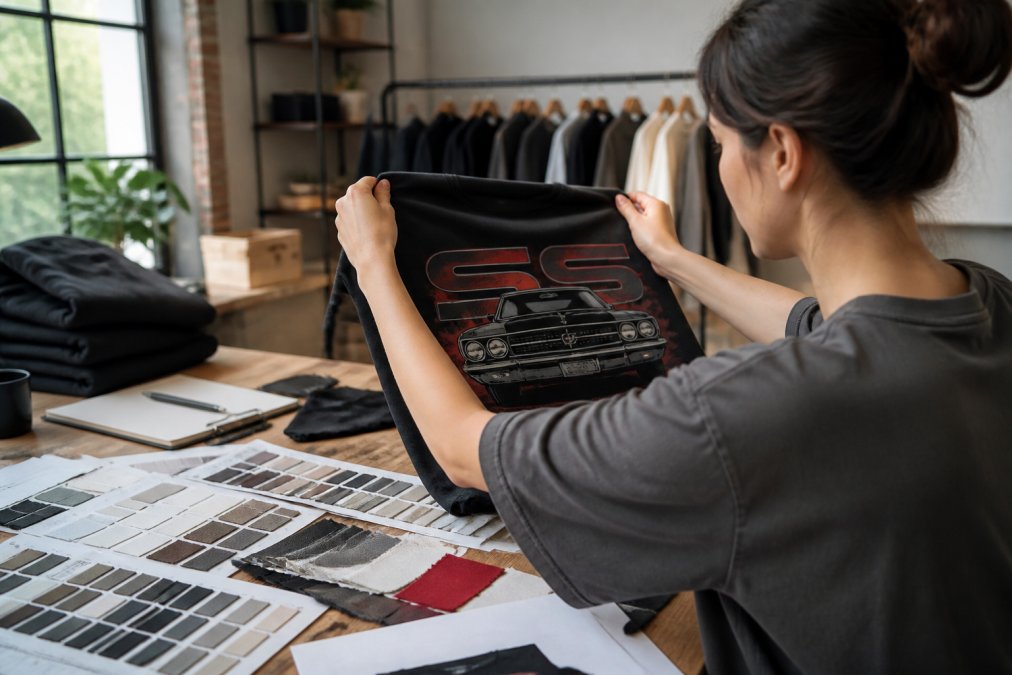
Manufacturing and Garment Construction
This is the longest stage, typically 7-14 business days depending on complexity. The garment is cut from fabric, the design is applied (through screen printing, embroidery, or direct-to-garment printing), and the pieces are assembled.
Screen printing is fastest for simple designs because the same screen can print hundreds of garments. Embroidery is slower because each design is stitched individually. Direct-to-garment printing (DTG) falls in the middle. Quality checks happen during this stage to ensure you receive quality apparel.
Quality Checks and Fulfillment
Before shipping, every garment is inspected. This stage takes 1-2 business days. The quality team verifies that the design is correct, the print or embroidery is clean and properly positioned, the garment fits the specified dimensions, and there are no defects in the fabric or construction.
Fulfillment includes packing, labeling, and preparing for shipment. This stage typically takes 1 business day. If any garments fail quality checks, they're remade, which adds 3-5 days to your timeline.
Shipping Duration and Estimated Arrival
Domestic U.S. shipping typically takes 3-7 business days depending on your location and the shipping method chosen. Standard shipping (5-7 business days) is the default for most vendors. Expedited shipping (2-3 business days) costs more but gets your order to you faster.
A typical timeline: order placed Monday → design approved Wednesday → production starts Thursday → garment completed the following Thursday → quality check Friday → ships Monday → arrives Thursday-Friday (5-7 days later). That's roughly 14 business days total from order to delivery. During peak seasons, add 5-10 days to this timeline.
Rush Orders and Expedited Shipping: Is It Possible?
Rush orders are possible but not always feasible. Most vendors can expedite production to 5-7 business days if they have capacity, but this requires paying a rush fee (typically 25-50% of the order total). Expedited shipping adds another 2-3 days but costs more than standard shipping.
The real constraint is production capacity. If a vendor is already running at full capacity, they can't rush your order without delaying others. During peak seasons, rush options may be unavailable entirely.
Rush Order Feasibility and Realistic Timelines
For a rush order to work, several conditions must be met: your design must be simple (single color, standard placement), you must approve the design immediately (same day), the materials must be in stock, and the vendor must have production capacity.
If all conditions are met, a rush order can be completed in 5-7 business days from order to shipment. Add 2-3 days for expedited shipping, and you're looking at 7-10 days total. That's still slower than ready-to-wear but significantly faster than standard made-to-order.
When you request expedited production, your design goes to the front of the production queue. The trade-off is cost and limited customization. Rush orders typically don't allow for complex designs or extensive customization because those take time. If you genuinely need something in 5-7 days, be prepared to pay 40-60% more than standard pricing and accept limited customization options.
Tracking Your Order: Digital Transparency and Order Status Updates
Most modern made-to-order vendors provide order tracking. You should be able to log into your account and see your order status at any time. Typical status updates include: order confirmed, design approved, in production, quality check, shipped, and delivered. Ortrends provides email notifications at each stage so you know exactly where your order stands.
How to Monitor Your Production Progress
Check your order status regularly. Most vendors send email notifications when your order moves between stages, but you can also log in to your account to see the current status. If your order seems stuck in one stage longer than expected, reach out to customer service.
Pay attention to the estimated delivery date provided when your order ships. This is based on the carrier's tracking information and is usually accurate within 1-2 days. If your package is delayed beyond the estimated date, contact the carrier directly.
What to Do If Your Order Is Delayed
Delays happen. Materials arrive late, production equipment needs maintenance, or the vendor underestimated capacity during a busy period. Reputable vendors proactively communicate delays. You'll receive an email explaining the delay and a new estimated delivery date.
Most vendors offer options if your order is significantly delayed: a partial refund, a discount on a future order, or expedited shipping on your delayed order at no extra cost. If your order is delayed and you have a specific deadline, communicate that immediately. Vendors may be able to expedite remaining stages or offer alternatives.
Planning Ahead: Tips for Ordering Made-to-Order Clothing Without Stress
The best way to avoid stress is to plan ahead. Understanding how far in advance to order for different scenarios prevents disappointment and last-minute panic.
How Far in Advance to Order for Special Events
For events with specific dates, order based on the season and your timeline:
| Event Timing | Order Window | Why This Matters |
|---|---|---|
| Off-peak (January-April, September) | 2-3 weeks before | Low vendor workload allows faster production |
| Shoulder season (May, October) | 3-4 weeks before | Moderate demand; some delays possible |
| Peak season (June, November-December) | 4-6 weeks before | High demand; significant delays if you wait |
| Last-minute (1-2 weeks before) | Rush order required | Costs 40-60% more; limited customization |
For Father's Day (mid-June), order by May 20th for standard delivery or June 1st for rush. For Mother's Day (mid-May), order by April 20th for standard delivery or early May for rush. For December holidays, order by November 20th for standard delivery or early December for rush.
If the event is important and you're cutting it close, budget for rush fees. It's better to pay extra and receive your order on time than to order late and miss the deadline.
The Fitting Process and Final Pick-Up Timeline
Made-to-order apparel typically ships directly to your address. When your order arrives, try it on immediately. Check the fit, the print quality, and the overall construction. If something is wrong, contact customer service within 7 days. Most vendors offer free replacements or returns if there's a manufacturing error.
For special events, allow 2-3 days between delivery and the event for any last-minute adjustments. If tailoring is needed (hemming, taking in seams), factor in an additional 5-7 days.
Common Mistakes That Slow Down Delivery
Several common mistakes extend timelines unnecessarily:
Delaying design approval: Every day you delay approving your design is one day added to your production start date. Approve within 24 hours.
Requesting design changes during production: Once production starts, design changes require restarting. Confirm your design before production begins.
Choosing uncommon colors or materials: Standard colors and materials are in stock. Specialty options require longer lead times.
Underestimating seasonal delays: Ordering during peak seasons without accounting for longer timelines is the most common mistake. Plan 4-6 weeks ahead during holidays.
Not communicating deadlines: If you have a specific deadline, tell your vendor when you order. They may be able to prioritize your order or suggest alternatives if the timeline is too tight.
Choosing the wrong shipping method: Standard shipping is slower but cheaper. If you need your order by a specific date, expedited shipping is worth the cost.
Understanding how long does made to order clothing take is essential for managing expectations and planning purchases strategically. The typical 2-4 week timeline reflects the reality of custom manufacturing, quality control, and shipping logistics. By understanding the factors that influence production speed and planning accordingly, you can receive high-quality custom apparel on your timeline.
At Ortrends, we've built our production process to deliver premium made-to-order graphic apparel without unnecessary delays. Our soft, durable materials keep their shape through dozens of washes, our designs are original and expressive, and we ship quickly from California to reach you faster. Whether you're ordering a Father's Day gift, a pet lover's collection piece, or a hoodie that celebrates your individuality, planning 2-3 weeks ahead ensures you receive exactly what you want, exactly when you need it. Shop Now and experience the difference quality customization makes.
Frequently Asked Questions
What does 'made to order' mean in clothing, and how is it different from ready-to-wear?
Made-to-order clothing is produced after you place your order, using your specifications or chosen design. Ready-to-wear is manufactured in bulk before sale. Made-to-order allows customization but requires a longer lead time because production doesn't start until your order is confirmed. This means you get a unique garment tailored to your preferences, but you'll wait longer than if you bought something already in stock.
How long does it typically take to receive made-to-order clothing?
Made-to-order clothing typically takes 2-4 weeks from order placement to delivery, depending on design complexity and current vendor workload. Simple graphic t-shirts may arrive in 10-14 days, while bespoke tailoring or intricate custom designs can take 4-8 weeks. Shipping duration from production facilities also affects your final delivery window. Always check the estimated arrival date when you place your order, as seasonal demand and supply chain factors can shift timelines.
What factors influence how long my custom garment will take to produce?
Several factors affect custom clothing production timelines: design complexity (simple prints are faster than multi-color embroidery), vendor production capacity (busy seasons mean longer queues), material availability (specialty fabrics may need sourcing), and order volume. Seasonal demand spikes, especially around holidays and Father's Day or Mother's Day, can add 1-2 weeks to lead times. Choosing standard materials and simpler designs helps reduce your overall fulfillment time.
Can I get made-to-order clothing faster with a rush order?
Rush orders are sometimes possible but depend on the vendor's current production schedule. Expedited options may reduce lead time by 3-7 days, though this isn't guaranteed during peak demand periods. Rush orders often cost more and work best for simpler designs. Contact your vendor early to ask about rush feasibility before placing your order. Keep in mind that shipping duration still applies, so even a rushed production may take 1-2 weeks total if it includes standard shipping.
This article was written using GrandRanker