

Spreadshirt vs Custom Ink: Which Print Quality Wins?
Table of Contents
- Spreadshirt vs Custom Ink: How We Tested Print Quality
- Print Quality Comparison: DTG vs Screen Printing
- Screen Printing vs Digital Printing Durability After 50 Washes
- Fabric Quality and Feel: What You Actually Wear
- Custom T-Shirt Printing No Minimums: Who Wins for Small Orders
- Pricing Models, Setup Fees, and Per-Unit Costs
- Design Tools and File Preparation Requirements
- Best Sites for Custom Graphic Hoodies: A Quick Assessment
- Which Service Delivers Better Quality for Your Money?
- Frequently Asked Questions
Last Updated: September 6, 2026
Spreadshirt vs Custom Ink: How We Tested Print Quality
Choosing between Spreadshirt vs Custom Ink for quality often comes down to how each platform applies ink to fabric, yet most comparisons never get past pricing screenshots. This guide breaks down the printing technologies, fabric standards, and durability factors that determine whether your design still looks sharp after month two.
The two services take fundamentally different approaches. Spreadshirt leans on print-on-demand flexibility with a marketplace model, while Custom Ink positions itself around bulk orders and decorated apparel for groups. Neither approach is inherently better, but each produces measurably different results depending on whether you need one shirt or one hundred.
Before comparing print quality, it helps to define what quality actually means here. Print quality is the combination of ink saturation, edge sharpness, and how well the design withstands repeated washing and wear. A technically perfect print that cracks after three washes fails the durability test, just as a soft-feeling shirt with a muddy, faded graphic fails the visual one.
Print Quality Comparison: DTG vs Screen Printing
The core difference between Spreadshirt and Custom Ink is direct-to-garment versus screen printing. DTG printing is a digital process where water-based inks are sprayed directly onto the fabric, similar to how an inkjet printer works on paper. Screen printing pushes thick layers of ink through a mesh stencil, depositing a heavier coating that sits on top of the fabric.
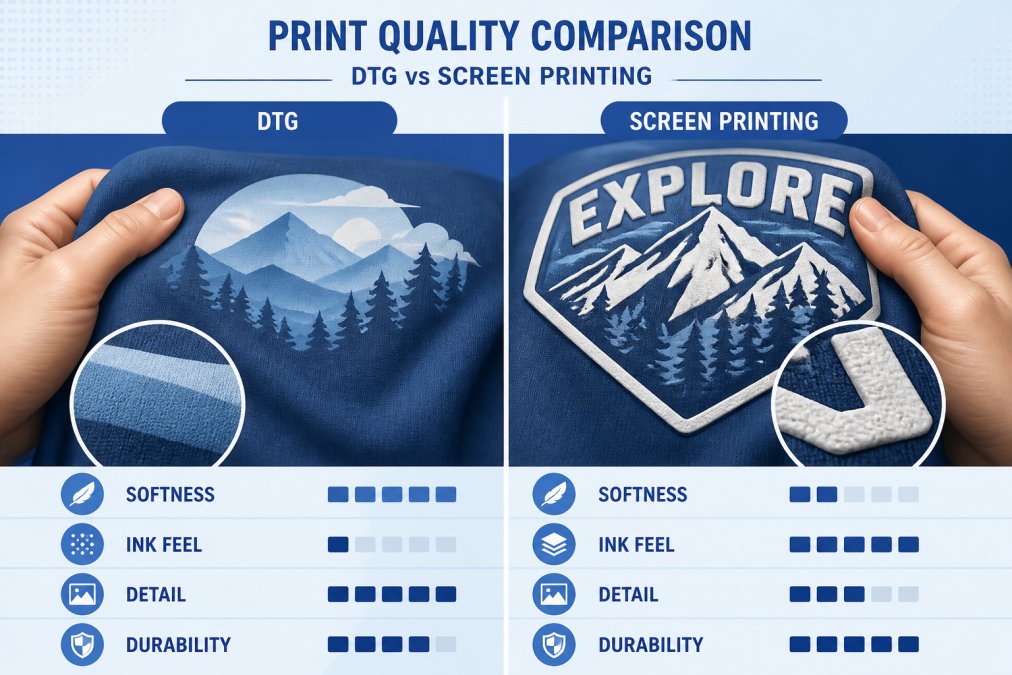
For photorealistic designs with gradients and fine detail, DTG produces superior results because there is no stencil limiting the color range. Screen printing excels at bold, flat colors and simple logos where the thicker ink layer delivers unmatched vibrancy. The trade-off appears in how each feels: DTG prints feel like part of the fabric, while screen printed designs have a noticeable raised texture you can feel when running your hand across the surface.
Custom Ink uses both methods depending on order size, switching to screen printing for larger runs to control costs. Spreadshirt primarily uses DTG for its print-on-demand model, which suits single-item orders but limits the heavy ink saturation that screen printing provides.
Screen Printing vs Digital Printing Durability After 50 Washes
Screen printing vs digital printing durability becomes clear after repeated laundering. Screen printed designs typically outlast DTG prints because the thicker ink layer resists abrasion and fading, provided the garment is washed inside out in cold water.
DTG prints have improved significantly, with modern water-based inks bonding to the fabric fibers rather than sitting on top. However, the longevity depends heavily on the garment quality and the printer's equipment. Lower-end DTG machines produce thinner ink layers that fade faster.
The common failure point is not the ink itself but the curing process. Both methods require heat to set the ink, and insufficient curing leads to premature cracking regardless of the technology. A well-cured DTG print on a quality cotton shirt can survive 50 washes with minimal fading, while a poorly cured screen print might crack within 10 (peer-reviewed research).
Fabric Quality and Feel: What You Actually Wear
The base garment matters as much as the printing method. Both Spreadshirt and Custom Ink offer a range of blanks, but the default options differ in weight and composition. Heavier fabrics around 6 ounces per square yard feel more substantial and hold their shape better than lightweight 4.5-ounce shirts that go see-through after a few washes (the FDA).
Cotton composition affects both print adhesion and comfort. 100% cotton shirts absorb DTG ink more effectively, producing brighter colors with better wash durability. Cotton-polyester blends feel softer and resist wrinkles, but the synthetic fibers do not hold water-based inks as well, leading to faded prints over time.
For hoodies, fabric weight becomes even more critical. A quality graphic hoodie should use a fleece-backed cotton blend around 8 ounces, providing warmth without the stiffness of cheaper synthetic alternatives. The interior brushing affects how the garment feels against skin, which matters for all-day wear.
Custom T-Shirt Printing No Minimums: Who Wins for Small Orders
Custom t-shirt printing no minimums is where Spreadshirt holds a clear structural advantage. Their print-on-demand model allows single-item orders without setup fees, making them ideal for personal projects or testing a design before committing to a bulk order. Custom Ink, by contrast, typically requires minimum order quantities for screen printing, though they do offer DTG options for smaller runs at a higher per-unit cost.
The per-unit economics shift dramatically with volume. Screen printing involves setup fees for creating screens and preparing the press, costs that amortize across the order. A 12-shirt order might carry a significant setup fee per color, while a 144-shirt order spreads that same cost across many more units, making screen printing the economical choice at scale.
Pricing Models, Setup Fees, and Per-Unit Costs
Pricing structures reveal how each platform makes money. Spreadshirt prices individual items higher to cover the on-demand production cost, with no quantity discounts until you reach modest thresholds. Custom Ink competes aggressively on bulk pricing, offering tiered discounts that improve as order size grows.
Setup fees are the hidden variable. Screen printing requires a separate screen for each color in your design, and these setup costs appear on your invoice regardless of the per-shirt price (sba.gov). A four-color design on a small order can double your effective cost per shirt. DTG carries no setup fees, keeping single-item costs predictable.
Design Tools and File Preparation Requirements
File preparation determines whether your final print matches your screen. Both platforms offer design interfaces, but their capabilities differ. Spreadshirt's tool works well for simple text and basic shapes, though it limits precision control over placement and sizing. Custom Ink provides a more strong editor with better alignment tools and more placement options.
Regardless of platform, the quality of your source file dictates the print outcome. Vector graphics using formats like SVG or EPS scale infinitely without losing sharpness, making them ideal for logos and text. Raster images like JPEGs and PNGs rely on pixel density, and low-resolution files produce blurry, jagged prints when enlarged.
Best Sites for Custom Graphic Hoodies: A Quick Assessment
For buyers weighing the best sites for custom graphic hoodies, the decision hinges on whether you prioritize single-item flexibility or bulk order consistency. Spreadshirt works well for ordering a single hoodie with a unique design, though their blank hoodie quality varies across the marketplace. Custom Ink offers premium blank options with consistent quality, but their structure favors larger orders.
The hoodie-specific factors to evaluate are fabric weight, fleece quality, and print placement. A hoodie needs a heavier fabric than a t-shirt to maintain its shape, and the print should sit cleanly across the chest without distortion from the fabric's stretch.
Which Service Delivers Better Quality for Your Money?
Neither Spreadshirt nor Custom Ink wins outright because the right answer depends on your order size and design complexity. For a single DTG-printed shirt with a detailed design, Spreadshirt offers the flexibility and no-minimum convenience. For bulk orders needing bold, durable screen printing, Custom Ink's volume pricing and premium blanks deliver better long-term value.
The quality equation also includes what happens after the purchase. Made-to-order apparel requires accurate color reproduction and consistent print placement across every unit, something both platforms handle adequately but neither perfects. For buyers prioritizing original designs on premium, comfortable materials, Ortrends offers made-to-order graphic apparel with a focus on soft, durable fabrics and fast shipping from California. Our collections cover everything from pet lover tees to nurse-themed apparel, each piece crafted with care to keep its shape and print through regular wear.
Choosing between Spreadshirt vs Custom Ink for quality ultimately comes down to matching the printing technology to your order size. Single items favor DTG flexibility, while bulk orders benefit from screen printing's durability and cost efficiency. If you value original, meaningful designs printed on premium materials that hold up to your active lifestyle, explore Ortrends' made-to-order collection. Every piece ships quickly from California, so you can wear your personality with confidence. Shop Now and experience apparel designed to last.
Frequently Asked Questions
Is Custom Ink high quality for bulk orders?
Custom Ink is generally considered high quality for bulk orders, especially when you choose screen printing for large quantities. Screen printing delivers thicker ink layers and better color vibrancy on runs of 24 or more shirts. Their customer service team also reviews every order for errors before production. However, for single shirts or small batches, their direct-to-garment printing quality can vary depending on the fabric blend you select.
Does Spreadshirt offer better print durability than Custom Ink?
Print durability depends more on the printing method than the company. Both Spreadshirt and Custom Ink use direct-to-garment (DTG) printing for most single-item orders, which bonds ink into the fabric fibers rather than sitting on top. For maximum wash durability, look for 100% cotton shirts. Both services offer screen printing for bulk orders, which generally outlasts DTG when properly cured.
What file formats do I need for the best print quality?
For crisp, professional results, upload vector graphics such as SVG, EPS, or PDF files. Vector files scale to any size without losing sharpness. If you only have raster images like PNG or JPG, make sure they are at least 300 DPI at the final print size. Low-resolution images will appear pixelated or blurry when printed, regardless of which service you choose.
Can I order custom t-shirts with no minimums?
Yes, both Spreadshirt and Custom Ink offer custom t-shirt printing with no minimums for direct-to-garment orders. This means you can order a single shirt with a custom design. The catch is that per-unit costs are higher for one-off orders compared to bulk quantities. If you need just one shirt, expect to pay a premium compared to the per-unit price of a 50-shirt order.