

Custom Ink Alternatives for Small Orders in 2026
Table of Contents
- Why Custom Ink Alternatives Matter for Small Batches
- Custom T-Shirt Printing No Minimum: What That Actually Means
- Screen Printing vs Direct to Garment for Small Orders
- Turnaround Time for Custom Apparel: What to Expect
- Print Quality and Durability: Avoiding Cracked Prints
- Hidden Costs in Small-Batch Printing
- How to Choose the Right Custom Apparel Provider
- Conclusion
Last Updated: August 28, 2026
Why Custom Ink Alternatives Matter for Small Batches
Most people assume small-batch custom apparel means choosing between two bad options: pay premium prices for print-on-demand or compromise on quality with budget vendors. That's not actually how the market works anymore. Custom ink alternatives for small orders have evolved dramatically, and understanding your options changes everything about what you can afford and what quality you can expect.
The real problem isn't finding someone who'll print a small order. It's finding someone who'll do it without treating you like a second-class customer. Bulk screen printing shops have minimum order quantities that eliminate small batches entirely. Print-on-demand platforms deliver speed but often sacrifice the aesthetic you're paying for. This is where custom ink alternatives step in, services designed specifically for the gap between one-off orders and bulk production runs.
At Ortrends, we've watched customers struggle with this exact tension. They want original designs, meaningful prints, and quality that lasts. But they're ordering in quantities of 10 to 50 units, not 500. That's where knowing your alternatives matters most. The difference between a cracked print after two weeks and a design that holds up for years comes down to which printing method you choose and which provider you trust with the execution.
Custom T-Shirt Printing No Minimum: What That Actually Means
Custom t-shirt printing no minimum sounds like a marketing promise, but it's worth understanding what it actually means in practice. When a provider advertises no minimum order quantity, they're not necessarily saying they'll print one shirt at a reasonable price. They're saying they can print one shirt if you're willing to pay for it.
The distinction matters because "no minimum" and "affordable for small orders" are different things. A print-on-demand service technically has no minimum, you can order a single shirt. But you'll pay a per-unit cost that reflects the overhead of that single production run. A provider offering custom ink alternatives for small orders might have a technical minimum of 5 or 10 units, but their per-unit pricing at that volume could be significantly lower than print-on-demand.
What you're really evaluating is the effective minimum: the point at which ordering becomes financially sensible. For direct-to-garment printing, that's often around 5-10 units. For screen printing, it's typically 25-50 units depending on the complexity of your design. For heat transfer methods, it can be as low as 5 units. The provider's stated "no minimum" policy matters less than understanding their actual pricing structure at your order size.
Setup fees also factor into this calculation. Some providers bundle setup into the per-unit cost. Others charge a separate setup fee that gets divided across your order. At 5 units, a $25 setup fee adds $5 to each shirt. At 50 units, it adds 50 cents. This is why small-batch orders require a different evaluation than bulk orders, the math shifts dramatically.
Screen Printing vs Direct to Garment for Small Orders
This is the core decision for custom ink alternatives. Screen printing and direct-to-garment (DTG) represent fundamentally different approaches to putting ink on fabric, and each has legitimate advantages depending on your specific situation.
When Screen Printing Makes Sense
Screen printing involves pushing ink through a mesh screen onto the garment. It's the traditional method, and it's still the gold standard for durability and color vibrancy, especially for solid colors and bold designs. The ink sits on top of the fabric rather than absorbing into it, which is why screen-printed designs can last for years without significant fading.
For small orders, screen printing makes sense when you're printing simple designs with a limited color palette. A single-color design on 25 shirts costs significantly less per unit than a five-color design, because each additional color requires a separate screen. The setup cost is real, typically $15-30 per color, but it gets distributed across your order. At 25 units, a three-color setup might add $2-3 per shirt. At 50 units, it drops to $1-1.50 per shirt.
The turnaround time for custom apparel using screen printing is typically 5-10 business days for small orders, depending on the provider's current workload. This assumes your design files are ready and approved. The fabric quality depends on what you're ordering, screen printing works equally well on premium cotton, blends, or performance fabrics. The durability is exceptional. A screen-printed design should maintain its appearance through dozens of washes if the garment itself survives that long.
Common mistake: assuming screen printing only works for simple designs. Modern screen printing can handle photographic images and complex multi-color work. But the cost scales with complexity, and at small order volumes, that complexity becomes expensive. A photorealistic design with 8+ colors might cost $3-5 per unit just in setup fees at a 25-unit order.
When Direct-to-Garment Wins
Direct-to-garment printing is the newer technology. It works like an inkjet printer for fabric, the printer applies colored ink directly to the garment in a single pass. This means you can print photographic images, gradients, and unlimited colors without the setup cost that screen printing requires.
For custom ink alternatives for small orders, DTG shines when you're printing complex, full-color designs. There's no per-color setup fee. You design it, upload it, and the printer produces it. The per-unit cost is consistent regardless of color complexity. A single-color design and a photorealistic multi-color design cost almost the same to print.
The turnaround time for DTG is typically 2-5 business days for small orders, making it faster than screen printing for most providers. The trade-off is durability. DTG ink sits in the fabric rather than on top of it, which means it integrates more naturally with the garment. But it also means it can fade faster than screen printing, particularly if the shirt is washed frequently in hot water or dried on high heat. A DTG print should last for years with normal care, but it won't have the same longevity as a screen-printed design under harsh conditions.
Quality variation is the other consideration. DTG relies on precise equipment calibration and proper fabric pre-treatment. A well-executed DTG print looks stunning, color accuracy is excellent and details are sharp. A poorly executed one shows visible banding or color inconsistency. Screen printing is more forgiving of equipment variation because the ink is applied mechanically under pressure.
Common mistake: choosing DTG for simple designs just because it's available. If you're printing a single-color logo on 50 shirts, screen printing will deliver better durability at a lower cost. DTG is the right choice when color complexity justifies its premium, not when simplicity doesn't require it.
Turnaround Time for Custom Apparel: What to Expect
Turnaround time for custom apparel is one of the most misunderstood aspects of small-batch ordering. When a provider says "5-7 business days," that's typically from the moment they receive your approved design files, not from the moment you place your order.
The actual timeline includes design approval, file preparation, and production. If you're uploading a design that needs revision, you're adding days. If the provider needs to request a higher-resolution file or color correction, you're adding more. The production time itself, the actual printing, is usually 1-3 business days for small orders, depending on the method.
Screen printing typically adds 5-10 business days total for small orders. This includes time for screen preparation, ink mixing if you need custom colors, and the printing run itself. Direct-to-garment is faster because there's no screen setup. Expect 2-5 business days for DTG small orders, though some providers offer rush service for an additional fee.
Shipping time is separate from production time. Most providers ship via standard ground shipping, which adds 3-5 business days depending on your location. If you need faster delivery, express shipping is usually available at a premium cost. Some providers, like Ortrends, ship from California, which affects delivery windows depending on where you are.
The real-world lesson: if you need custom apparel in two weeks, you need to account for 2-3 days of design preparation and approval, 3-7 days of production, and 3-5 days of shipping. That's 8-15 days minimum. Ordering with only a week to spare almost guarantees missed deadlines or expensive rush fees.
Print Quality and Durability: Avoiding Cracked Prints
The most common complaint about custom apparel is cracked prints. You receive the shirt, it looks great, you wear it a few times, and suddenly the print is splitting and peeling. This happens because of either poor printing technique or incompatible materials, and knowing the difference helps you avoid it.
Cracking typically occurs when the ink doesn't bond properly to the fabric. With screen printing, this happens when the ink is applied too thick, the fabric isn't pre-treated correctly, or the curing process is rushed. With DTG, it's usually the result of improper fabric preparation or using ink that isn't designed for the specific fabric weight. Heat transfer methods are particularly prone to cracking if the temperature or pressure isn't calibrated correctly.
Durability also depends on the fabric itself. A heavy-weight cotton (14+ oz) holds ink better than a lightweight shirt (4.3 oz) (peer-reviewed research). Performance fabrics with moisture-wicking properties sometimes resist ink adhesion and require special pre-treatment. Natural fibers bond better with most inks than synthetic blends. This is why premium apparel providers specify the exact fabric weight and composition they recommend for each printing method.
The quality difference between providers is real and visible. A well-executed screen print has crisp edges, even color saturation, and ink that feels integrated with the fabric rather than sitting on top of it. A well-executed DTG print has photographic clarity and color accuracy. A poorly executed print from either method shows visible defects: uneven ink coverage, color bleeding, or ink that flakes off immediately.
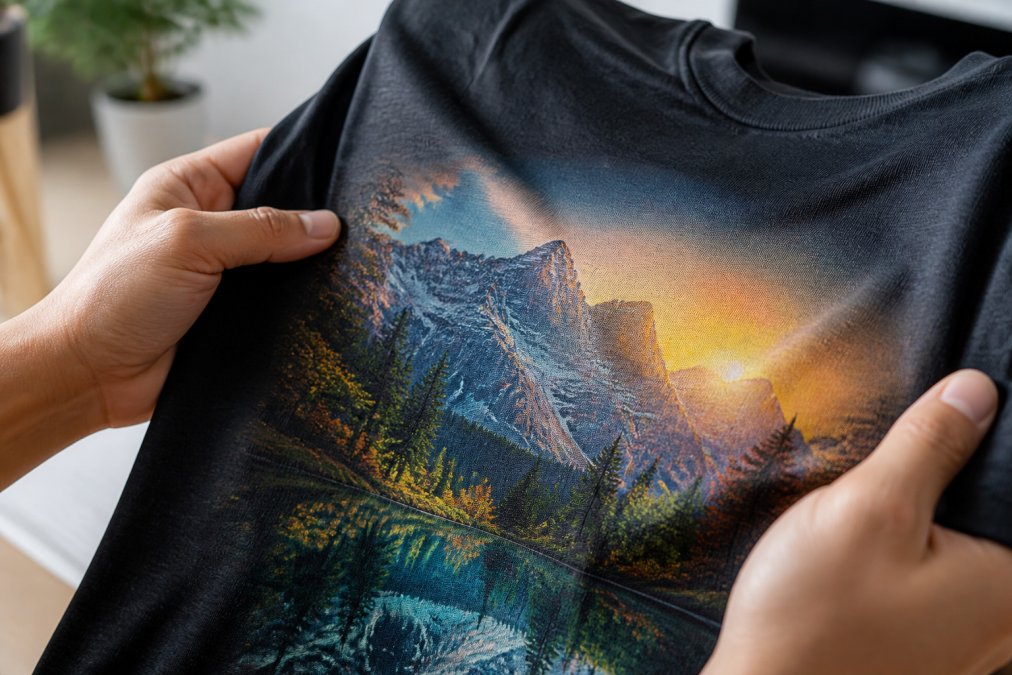
Customer reviews are the most reliable indicator. If a provider's customers consistently report prints lasting through dozens of washes, that's evidence of proper technique. If reviews mention cracking or fading after a few washes, that's a red flag regardless of how attractive their website is.
Ortrends prioritizes durability by using premium materials and proven printing methods. The designs are tested for wash durability, and the apparel itself is selected for quality that withstands active lifestyles. This commitment to lasting quality is why customers report that their Ortrends pieces hold up through years of wear.
Hidden Costs in Small-Batch Printing
The advertised price per shirt rarely tells the full story. Understanding hidden costs is essential to making an accurate comparison between custom ink alternatives for small orders.
Setup fees are the most obvious hidden cost. If a provider charges $20 per color for screen printing, a three-color design on a 25-unit order adds $2.40 per shirt. That's not hidden, it's usually disclosed, but many people don't factor it into their comparison. Design upload fees, file preparation charges, and color matching fees are less common but do exist at some providers.
Shipping costs scale unpredictably with order size. A 25-unit order might cost $15-20 to ship. A 50-unit order might cost $25-30, not double. But international shipping, overnight delivery, or specialty packaging can add significantly to your total cost. Some providers include shipping in their per-unit pricing. Others charge it separately. This difference alone can swing your decision.
Minimum order fees are another hidden cost. Some providers charge a flat fee if your order is below a certain threshold, say, a $50 minimum order value. If you're ordering 10 shirts at $8 each, you're at $80, so no issue. But if you're ordering 5 shirts at $12 each, you're at $60, which might trigger a $10 minimum order fee, bringing your true cost to $70 for 5 shirts instead of 5 shirts at $12 each.
Custom color matching is expensive. If you want a specific Pantone color that requires ink mixing, expect to pay $10-25 for color matching on top of your printing cost. This is unavoidable if you need exact color accuracy, but it's worth knowing upfront.
Revision fees can add up if your design needs changes after initial submission. Some providers include one or two revisions. Others charge $5-15 per revision. If you're not certain about your design, clarify the revision policy before ordering.
Rush fees are the most transparent hidden cost, but they're still easy to underestimate. A 50% rush fee on a $500 order adds $250. If you're ordering last-minute, budget for this.
How to Choose the Right Custom Apparel Provider
Evaluating custom apparel providers for small orders requires looking beyond the website and pricing calculator. The right provider depends on your specific priorities: cost, quality, speed, design complexity, or customer service.
Start by matching your design to the right printing method. If you have a simple logo or single-color design, screen printing providers will likely offer the best value. If your design is photorealistic or multi-color, DTG providers become more competitive. This decision narrows your options significantly.
Next, evaluate the provider's minimum order quantity against your actual order size. If you're ordering 5 units, print-on-demand and DTG are your realistic options. If you're ordering 50 units, screen printing becomes viable. If you're ordering 100+, bulk screen printing providers start becoming competitive despite their higher minimums.
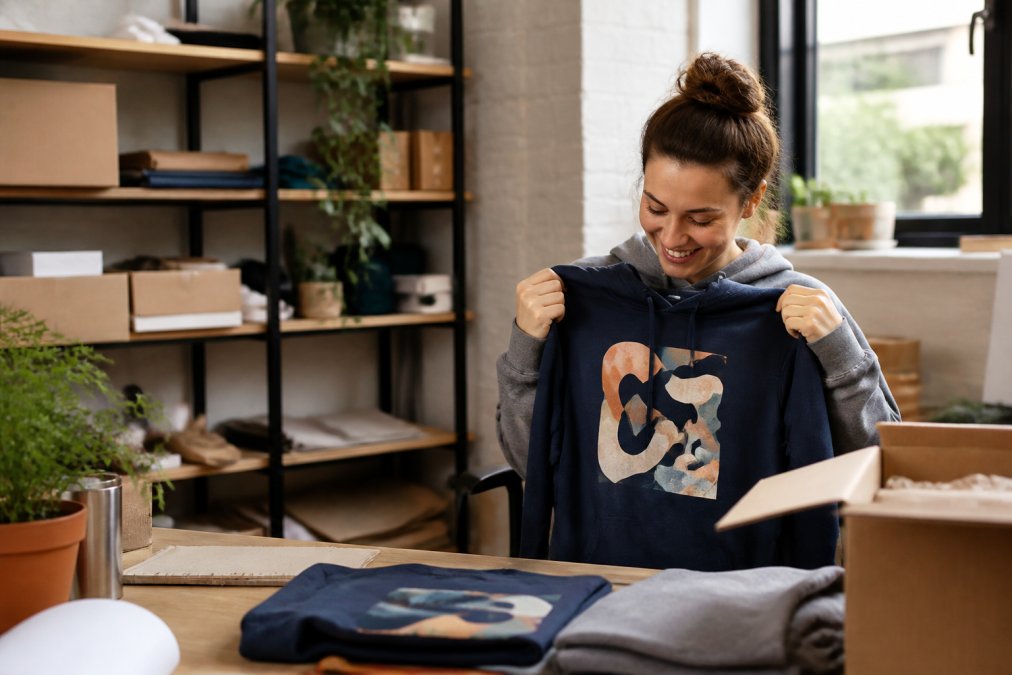
Quality indicators matter more than claims. Look for customer reviews that specifically mention durability, print accuracy, and customer service. A provider that responds to negative reviews professionally and offers solutions is more trustworthy than one that ignores complaints. Check if they provide samples or have a sample order option, this is the most direct way to evaluate their quality.
Turnaround time should match your deadline. If you need custom apparel in two weeks, a provider with a 10-day production timeline plus 5 days of shipping won't work. Be realistic about your timeline and choose accordingly.
Customer service accessibility matters for small orders. When something goes wrong, and occasionally it does, you want to reach a human who can help. Check if the provider offers phone support, email support, or live chat. Read reviews about response times. A provider that takes 48 hours to respond to questions is problematic when you're on a tight timeline.
Fabric and apparel quality is non-negotiable. Premium providers specify the exact garment they use, brand, weight, composition, rather than vague descriptions like "quality cotton." Ortrends, for example, uses premium materials selected specifically for comfort and durability, with designs that celebrate individuality. This specificity is a signal that the provider cares about the foundation their printing sits on.
Pricing transparency is a practical indicator of trustworthiness. Providers that clearly explain their pricing structure, setup fees, and shipping costs are easier to evaluate than those that hide details until you're in the checkout process. Compare total cost, not per-unit cost.
Design capabilities should match your needs. If you need custom ink alternatives for small orders with complex artwork, confirm the provider can handle your file format and resolution requirements. Some providers accept vector files only. Others accept raster images. Some require minimum DPI for print quality. Understanding these requirements upfront prevents frustration and revision cycles.
The custom apparel market has fragmented into specialized providers, each optimized for different order sizes and design types. The providers that thrive aren't competing on price alone, they're competing on reliability, quality, and understanding the specific constraints of small-batch production. When you're evaluating custom ink alternatives for small orders, you're not just comparing prices. You're choosing a partner who understands that your 25-unit order matters as much as someone else's 500-unit order. Ortrends operates from this philosophy: every order deserves premium materials, careful execution, and fast shipping from California. The difference shows in durability, design quality, and customer satisfaction. Start with your design and timeline, match them to the right printing method, and choose a provider whose track record matches your standards.
Frequently Asked Questions
What are cheaper alternatives to Custom Ink for small orders?
Print-on-demand platforms, direct-to-garment printers, and local screen printing shops often offer competitive pricing for small batches. Print-on-demand eliminates setup fees and minimum orders, while DTG services charge per-item with no MOQ. Local screen printers may negotiate on setup fees for small runs. Compare per-item cost, setup fees, and turnaround time across options to find the best value for your specific order size and timeline.
Where can I find custom t-shirt printing with no minimum order?
Print-on-demand services and direct-to-garment printers specialize in single-item and small-batch orders. These platforms let you upload your design, choose apparel, and order as few as one shirt without MOQ penalties. DTG providers handle orders of 1-50 units efficiently. Some local screen printers also accept small runs, though they may charge higher per-item costs. Check design upload requirements and file specifications before ordering to avoid delays.
How long does turnaround time for custom apparel typically take?
Turnaround depends on printing method. Print-on-demand usually ships within 3-7 business days after order placement. Direct-to-garment services range from 2-5 business days for production plus shipping. Screen printing for small batches takes 5-10 business days due to setup time. Shipping adds 2-5 days depending on your location and carrier. Fast shipping options exist but cost extra. Plan ahead if you have a specific deadline, and confirm production timelines before ordering.
Should I choose screen printing or direct-to-garment for a small batch?
Direct-to-garment works best for orders under 50 units with complex, multi-color designs and no MOQ. It offers superior color matching and design precision. Screen printing becomes cost-effective at 25+ units with simple designs (1-3 colors) and offers excellent durability and wash resistance. DTG has higher per-item cost on small runs but no setup fees. Screen printing has setup costs but lower per-item pricing on larger batches. Consider design complexity, order size, and budget when deciding.
This article was written using GrandRanker